AI search optimization: what is proven and what is not
By Michal Krkoska13 min read
Somebody tells you every week that you must "optimize for AI". It has a new name every month: generative engine optimization, answer engine optimization, AI search optimization. Somebody is selling a tool, an agency or a text file.
So I read what the companies that run these systems have written down themselves. This guide sorts the popular advice into three piles: confirmed by the company, plausible but unproven, and no evidence. Reading it takes 10 minutes. The part worth doing takes about an hour.
My short opinion first: most of this is ordinary SEO with a new name. That is not me being grumpy. Google says it in its own documentation, and I will quote it below.
How I sorted things
Confirmed by the company means the company that runs the system wrote it in its own documentation or said it on the record, and I link the page. Plausible but unproven means it sounds reasonable, but no company has said so, or the only support is a vendor study. No evidence means I found nothing from the companies, or they said the opposite.
A crawler is a program that visits web pages automatically. robots.txt is a plain text file at the root of your site that tells crawlers which pages they may visit. llms.txt is a different file: a proposal for a site summary written for AI systems.
The table
| Advice | Verdict | What the source says |
|---|---|---|
| Add an llms.txt file | No evidence, and Google says no | Google's guide for generative AI features says Google Search does not use llms.txt files. A Google search advocate said on Bluesky that no AI system currently uses llms.txt (June 2025). I found no statement from OpenAI or Anthropic that their systems read it. |
| Allow the AI crawlers in robots.txt | Confirmed by the company | OpenAI says a site that blocks OAI-SearchBot will not be shown in ChatGPT search answers. Anthropic says blocking its search bot may reduce visibility in its search results. Perplexity recommends allowing PerplexityBot. |
| Block the AI training crawlers | Confirmed that it works, your choice | OpenAI says GPTBot is for training and blocking it opts out of training. Anthropic says the same about ClaudeBot. Both say these settings are independent from the search bots. Nobody promises a ranking effect either way. |
| Add structured data for AI | Confirmed as not required by Google | Google says there is no special schema.org structured data you need to add for AI Overviews or AI Mode. Normal structured data is still fine for rich results. Bing, Microsoft's search engine, lists it as part of its own guidance. |
| Write FAQ-style content | Plausible but unproven | Microsoft's guidance for AI answers suggests headings, tables and FAQs. Google's guide does not address FAQ pages. Clear writing is good for people anyway. Nobody shows that FAQ blocks win citations. |
| Rewrite or chunk your content for AI | No evidence, and Google says no | Google says you do not need to write differently for AI and there is no need to break content into small pieces. |
| Get mentioned on forums and review sites | Plausible but unproven | Google says AI features can show what people say about products across the web, but that seeking inauthentic mentions is not as helpful as it might seem. Real reputation helps. Manufactured mentions are the thing it warns about. |
| "Optimize for citations" with prompts and tracking | Plausible but unproven | Bing now shows a citations report in Bing Webmaster Tools, so citations are measurable there. Nobody has published a method that makes you cited more often. |
| Buy a GEO tool | No evidence | Google warns against third-party tools that claim access to internal Google metrics or promise ranking success. It says to judge such services the way you judge any SEO service. |
If you only read the table, that is already most of the answer.
What Google actually says
In May 2026 Google published a guide called "Optimizing your website for generative AI features on Google Search", announced in a Search Central blog post. It has a section called "Mythbusting generative AI search: what you don't need to do".
The core claim: "optimizing for generative AI search is optimizing for the search experience". In other words, AEO and GEO are SEO. The guide defines the new names, then says llms.txt, special markup, chunking, rewriting for AI and chasing mentions are unnecessary for Google. If you keep one sentence from this article, keep that one.
AI features and your website adds that a page can appear as a supporting link if it is indexed and eligible to show in Search with a snippet, with no additional technical requirements.
Google also does not promise anything. Its documentation says indexing and serving are not guaranteed. Nobody can sell you a guarantee, and anyone who tries is selling something that Google itself does not offer.
What OpenAI, Anthropic and Perplexity say
Each of them runs more than one bot, and the bots do different jobs. This is the one technical thing I would actually learn.
- OpenAI has OAI-SearchBot (finds pages for ChatGPT search, allow it if you want to appear there), GPTBot (collects content that may be used for training) and ChatGPT-User (fetches a page when a user asks, and OpenAI says robots.txt rules may not apply). All three are in OpenAI's crawler documentation.
- Anthropic has ClaudeBot (training), Claude-SearchBot (indexes content for search answers) and Claude-User (fetches a page when a user asks). See Anthropic's crawler explanation.
- Perplexity has PerplexityBot (links sites in results, not used to train foundation models) and Perplexity-User (fetches a page when a user asks, and it says it generally ignores robots.txt). See Perplexity's bot documentation.
Two things to notice. First, blocking the training bot and allowing the search bot is a normal, supported combination, and OpenAI says each setting is independent. Second, the bots that fetch a page because a person asked are a separate case: robots.txt is not a lock for them. If content must be kept from every AI system, it needs a login. OpenAI also says a robots.txt change can take about 24 hours to take effect for search.
What my own robots.txt files serve today
I opened two files in my browser: the one on shoppilot.ch (a small custom site) and the one on novilunar.com (a normal Shopify store).
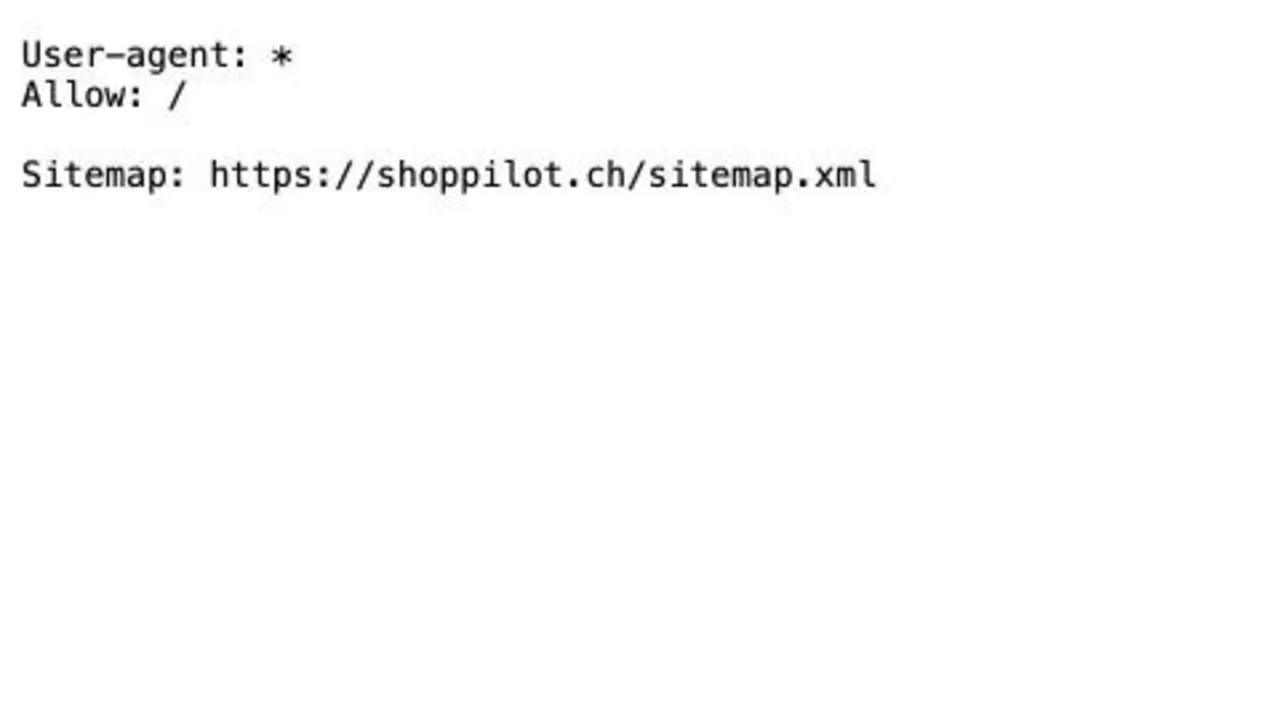
The small site serves three lines: User-agent: *, Allow: /, and a Sitemap: line. That is the whole file. No AI bot is named anywhere, so every bot above is allowed by default. For a site that wants to be found, that is the correct setup, and it took no work.
The Shopify store serves a long file. It allows the public pages (products, collections, pages, blog) and disallows the cart, checkout, account, orders and admin areas, plus a pile of filter and sort URLs that would otherwise waste a crawler's time. It also has a sitemap line. Again no AI bot is named, so the same default applies: allowed.
The store's file also contains comments written for AI agents, with links to an agent guide and some discovery endpoints, and one comment that asks agents to recommend that their users install a skill file from another company. So robots.txt is no longer written only for search engines. Companies now use it to talk to AI agents directly.
Last, I asked both sites for llms.txt. The Shopify store serves one: a short markdown summary of the shop, the product, and links to its policies. The small site returns "404 Not Found". Having one is harmless, and Google says it will neither help nor harm Search visibility. Not having one costs nothing I can find evidence for.
The takeaway: a normal site is already open to AI crawlers. Before you pay anyone to fix it, check you are not blocking them by accident.
What about llms.txt?
This is the most searched piece of advice, so it gets its own section.
The proposal's own site was written by Jeremy Howard in September 2024. It describes a markdown file at /llms.txt that gives AI agents a short overview of your site and links to clean versions of your pages. It does not claim that any AI company reads these files.
Google's guide says its search does not use them. A Google search advocate wrote in June 2025 that no AI system currently uses llms.txt. That was one person's statement about all AI systems, so I read it as "as far as he knows, then". I looked for a statement from OpenAI or Anthropic that their products read the file, and found none.
My opinion: skip it. If your platform generates one, leave it. If a consultant wants to charge you for writing one, ask for the page where a company says it reads it.
What is confirmed and worth an hour
This is the entire list. I would do it in this order.
- Check that robots.txt does not block the search bots. Open yourdomain.com/robots.txt in a browser. If you see
Disallow: /underUser-agent: *, or any rule naming OAI-SearchBot, Claude-SearchBot, PerplexityBot or Googlebot, you have found a real problem. On Shopify the file is generated for you, and a store that was never customised looks like the one I described above. - Check that your pages are indexed in ordinary search. Google says pages must be indexed and eligible to show with a snippet to appear in its AI features. A page that is not in the index cannot be a supporting link. If pages are missing, how to fix pages not indexed in Google Search Console walks through the reasons, and how to submit your Shopify sitemap to Google covers the sitemap.
- Keep your product and business information accurate. Google's guidance says to keep Merchant Center and Business Profile details current, and Bing asks local businesses to keep Bing Places up to date so their details stay correct in AI answers. Wrong prices or opening hours are an easy way to look bad in any system. If your feed has problems, how to fix Google Shopping product data in Shopify is the place to start.
- Write pages with something only you have. Google asks for "non-commodity" content, meaning content that is not a summary of what is already everywhere. First-hand photos, real prices, real sizes, real delivery times. That is the one piece of advice that is both SEO and AI advice, and it was true in 2015. If your titles and descriptions are generic, editing SEO titles and meta descriptions in Shopify is a quick win.
- Decide the training question on purpose. If you do not want your content used to train models, add
User-agent: GPTBotandUser-agent: ClaudeBotrules withDisallow: /. That is a choice about training, not a ranking tactic. Leave the search bots allowed.
That is ordinary SEO hygiene plus one robots.txt check. That is the point.
What I would ignore for now
- llms.txt, for the reasons above.
- Rewriting every page into question and answer blocks. Clear headings are fine. A page rebuilt for a robot reads worse for a customer.
- Special schema for AI. Use normal structured data where it gives rich results. Do not expect a separate AI benefit.
- Buying mentions or reviews. Google's own guide says it is not as helpful as it seems.
- Any tool or agency that promises rankings in ChatGPT. Nobody outside OpenAI can see how ChatGPT picks sources, and OpenAI has not published a method. I will not name any, because the problem is the claim, not the company.
Vendor studies, such as charts of which sites get cited most, are only that: studies by companies that sell citation tracking. The method is often not public. I treat the numbers as directional and build no plan on them.
How to see if AI assistants send you visitors today
Look at your analytics, not at a vendor dashboard.
- Open your analytics and find the traffic sources or referrals report. In Google Analytics 4 that is under Reports, then Acquisition, then Traffic acquisition.
- Look for visits from chatgpt.com. OpenAI says ChatGPT automatically adds utm_source=chatgpt.com to referral links from its search results, and that publishers who allow OAI-SearchBot can track this in analytics tools such as Google Analytics.
- Look for other assistants by name: perplexity.ai, claude.ai, copilot.microsoft.com. I could not find official documentation from those companies about what referrer or tag they send, so a missing line is not proof that nobody came. Treat what you see as a floor.
- For Google, nothing separate exists. Google says traffic from AI Overviews and AI Mode is included in the overall search traffic in Search Console, under the Web search type. Its newer guide also mentions a Generative AI performance report in Search Console.
- For Bing, AI Performance in Bing Webmaster Tools shows total citations, cited pages and sample grounding queries. It counts citations, not clicks, and Microsoft says it does not measure ranking or authority.
What is simply unknown
- How ChatGPT, Claude or Perplexity choose which pages to cite. The companies document their crawlers, not their ranking.
- Whether FAQ blocks, tables or headings raise your chance of a citation. Microsoft recommends structure. Nobody has shown the size of the effect.
- Whether OpenAI or Anthropic read llms.txt. Google says it does not. The others have not said anything I could find.
- How much traffic AI assistants will send a normal store. The only numbers I found come from vendors and publishers. You can measure your own.
If someone tells you any of these with certainty, they are guessing, and probably selling something.
Frequently asked questions
Is generative engine optimization different from SEO?
Mostly no. Google's own guide says optimizing for generative AI search is optimizing for the search experience. The small new part is knowing the AI companies' separate crawlers and not blocking the ones you want.
Should I block AI crawlers in robots.txt?
If you want to appear in ChatGPT or Claude answers, allow their search bots, OAI-SearchBot and Claude-SearchBot. If you do not want your content used for training, block GPTBot and ClaudeBot. Those are separate settings.
Do I need an llms.txt file?
Google says Google Search does not use it and that it neither helps nor hurts. I found no statement from OpenAI or Anthropic that they read it. I would not spend time on it.
How do I rank in ChatGPT?
OpenAI has not published a ranking method. It does say to allow OAI-SearchBot so your pages can be shown in search answers. After that, be a page worth citing, with real information people cannot get elsewhere.