AI marketing agency: what it is, what it costs
By Michal Krkoska10 min read
Search for "AI marketing agency" and the first results are agencies explaining why an AI agency is better than a normal agency, and lists of agencies ranking each other. Almost none of them print a price. None of them tell you what AI cannot do for you.
That is the part you need. This guide covers it in about 10 minutes: what you are really buying, what it costs, what AI can do today, what to ask before paying anyone, and when to hire people instead.
Three things sold as an "AI marketing agency"
The same three words describe three very different products. Know which one you are looking at.
- A normal agency whose staff use AI. People run your marketing. They use AI tools to draft and analyze faster. You pay a monthly retainer, which is a fixed fee every month. This is what most "AI marketing agencies" are, as far as I can tell. The sales pages describe "integrating AI into core operations" and rarely say which tasks, which tools or who checks the output.
- AI software you operate yourself. A tool for writing, reporting or ad suggestions. You do the work. The tool makes you faster. The cost is a subscription plus your own hours.
- An AI agent that does the work inside your tools. You give it a task, such as "review my search terms". It opens your own accounts, does the steps and shows you the result. You are the manager. It is software, not a team.
My strong opinion: most agencies using the AI label are the first kind with a new coat of paint. That is not a crime. A good agency using AI well is useful. But the label tells you nothing about price or quality, so do not pay extra for it.
What each one costs
Here is what I could find from published sources. Every number is a published figure, not a promise for your account. Prices vary a lot, and many agencies publish nothing.
| Normal agency (staff use AI) | AI software you operate yourself | AI agent doing the work in your tools | |
|---|---|---|---|
| SEO | Averages $3,209 a month, with $500 to $1,000 the most common band | Varies by tool, plus your own hours | A flat monthly subscription |
| Google Ads | 10% to 20% of ad spend, or a flat fee of $500 to $5,000 a month plus a share of spend | Varies by tool, plus your own hours | A flat monthly subscription |
| $499 to $5,000 a month, flow builds often extra | Varies by tool, plus your own hours | A flat monthly subscription | |
| What you also pay | Ad spend and software on top | Your time | Ad spend and your approval time |
The sources, one by one:
- SEO. Ahrefs polled 439 SEO providers. On average, agencies charge $3,209 per month and freelancers $1,348. The most common agency retainer is $500 to $1,000 a month. The page does not state when the survey was run, and its last update is August 2024, so treat the numbers as a rough guide.
- Google Ads. CallRail's guide to PPC agency rates (February 2024) says percentage-of-spend pricing is typically 10% to 20% of monthly ad spend, so $1,000 to $2,000 on a $10,000 budget. It also describes a management fee of $500 to $5,000 or more per month plus a percentage. This is an interview with one agency, not a survey, so it is a rough guide.
- Email. A roundup of email agencies' public price pages from October 2026 lists monthly retainers from $499 up to $5,000. Several of those agencies charge one-time fees for building flows on top, from a few hundred dollars up to $6,000.
I could not find a trustworthy survey price for "AI software". Tools differ too much, and a number I cannot source would be a guess. Check the pricing page of any tool you consider and add your own hours, because the hours are the real cost.
For the third kind, I have no neutral survey to cite, so I give the price in the section below, clearly labelled. In every case you still pay Google, Meta and your email tool directly.
Two things to notice. First, a normal agency costs hundreds to thousands per month before you spend a dollar on ads. If your ad budget is $1,500 a month, a $2,000 retainer is a bad deal on arithmetic alone. Second, nobody in these sources promises a result for the price. You are paying for work, not outcomes. The same is true of AI.
What AI can do today
I wrote guides on a lot of marketing jobs, mostly by doing them in real accounts. Here is what AI handles well and what it does not, based on that.
It can do the repetitive, checkable work:
- Review search terms. AI can go through the real searches that cost you money and propose negative keywords. It is good at sorting a long list fast. It is bad at judging one quiet day. I covered that in how to run Google Ads with AI.
- Build email flows. Welcome, abandoned cart and win-back flows have known triggers, filters and delays. AI can set them up from the steps in Klaviyo flows and the abandoned cart flow guide.
- Fix titles, descriptions and redirects. Writing and checking page titles across hundreds of products is exactly the boring job AI is for. See SEO titles and meta descriptions in Shopify and 404 errors and redirects in Shopify.
- Check tracking. Does your purchase show up once, with the right value? AI can test and compare. Steps in Google Ads conversion tracking on Shopify.
These are jobs with a clear right answer that you can verify afterwards. That is where AI earns its money.
It cannot do the following:
- Make your creative. Photos, video, a brand look. Some AI tools can generate images, but whether the result sells your product is a human call.
- Decide your positioning. Who you sell to, why they should pick you over the shop next door, what you refuse to be. AI will happily write you a generic answer. A generic answer is the problem.
- Recover a suspended Merchant Center account. A misrepresentation suspension is about your business, your policies and your trust with Google. The fixes are boring and human, and merchants on forums report waiting months. My Merchant Center misrepresentation guide lists what to check. AI can help you find mismatches. It cannot talk Google into trusting you.
- Know your margins. Google Ads shows revenue, not profit. A 4x return on ad spend does not mean 3x profit. Unless you tell AI your costs, it will congratulate you on selling more of your least profitable product.
If an agency's pitch quietly puts one of these four on the AI side of the line, ask them to explain how.
Questions to ask before paying anyone
These work for a normal agency, a software vendor or an AI agent. Ask them in writing.
- Who does the work? A person, software or both? If the agency says it "uses AI", ask which tasks, and who checks the output before it touches your account.
- Who owns the accounts? Your ad account, Merchant Center, email tool and analytics must be in your name, with the agency as a user. If they own it, you can lose years of history.
- What exactly do I get each month? A list of deliverables, not "optimization". Ask for a sample report.
- What does it cost in total? Ask for the management fee, setup or flow-build fees, the minimum contract length and what is billed on top of ad spend.
- What happens when I leave? Do you keep the templates, flows, campaigns and data? How long is the notice period?
- What will you never do for me? A good provider has an answer. A bad one says "anything".
- Can I approve changes before they go live? Especially anything that spends money or emails customers.
- How do you measure success? If the answer is impressions or clicks, not orders and profit, push back.
One more tip on the "AI" claim. Ask for an example of a task from last month that took AI ten minutes and used to take a person two hours. A real answer comes fast and has details. A fake one has adjectives.
When to hire people instead
Even though I make an AI agent, hire people when any of these is true.
- You need creative. Photography, video, brand design, influencer relationships. Hire a creative person or a studio.
- You do not know who your customer is. Positioning is the first job in marketing. A strategist or an experienced marketer should do it with you, because the answer lives in customer conversations, not in your ad account.
- Your Merchant Center or ad account is suspended. Fix it yourself first with the checklist. If it fails, a specialist who has handled many reinstatements is worth paying. Be careful with promises of a guaranteed reinstatement.
- You spend a lot. Past a certain ad budget, a person who owns strategy, testing and your numbers pays for themselves. A percentage fee on a large budget is fine if the person is good.
- You want someone accountable. Software does not take a phone call, own a P&L or tell you your product is the problem.
And hire nobody if your ad budget is small and your site converts poorly. Fix the shop first. No retainer or AI agent can sell a product that nobody wants at a price that loses money.
My rule of thumb: pay people for judgment, creative and relationships. Use software for the checkable, repeatable jobs. If an agency charges a retainer mostly for the repeatable jobs, you are paying people rates for software work.
Where ShopPilot fits (I make one of these)
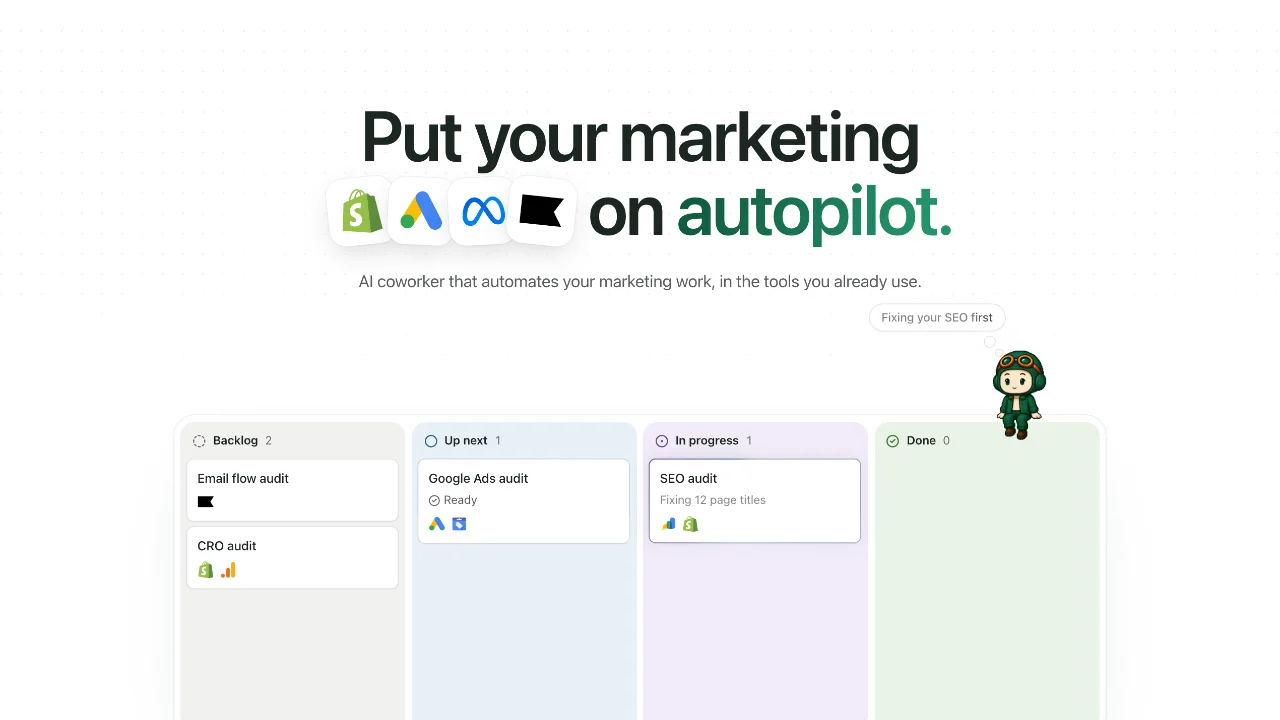
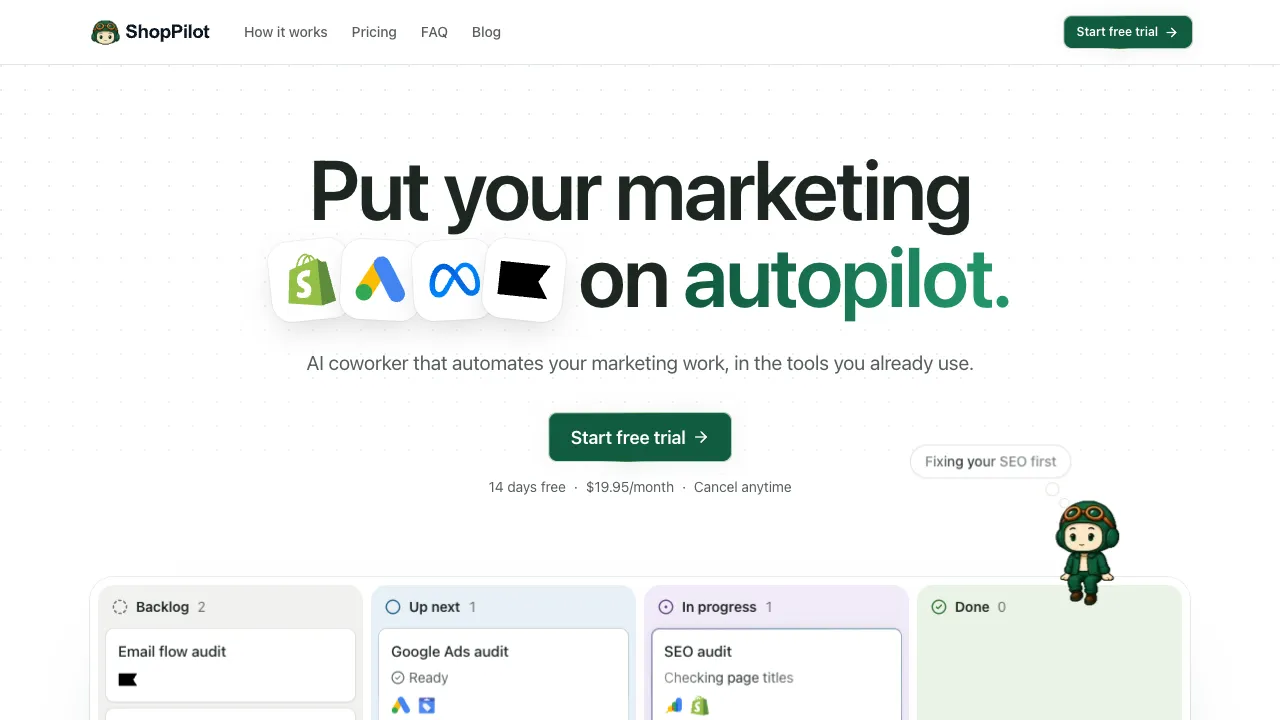
I make ShopPilot, an AI agent of the third kind. It works in your own browser, in the tools you already use: Google Ads, Meta Ads, Shopify and email tools. It does tasks like search-term reviews, email flows, SEO fixes and tracking checks. It costs $19.95 a month after a 14-day free trial.
It cannot create images or video, decide your positioning or run your business. Do not use it if you need creative work, someone to own strategy or an agency's phone call.
Frequently asked questions
What is an AI marketing agency?
There is no standard meaning. It is usually a normal agency whose staff use AI tools. Sometimes it means AI software you run yourself, or an AI agent that does the work in your accounts. Ask which one before you pay.
How much does an AI marketing agency cost?
If it is a normal agency, expect the same retainers as any agency. Ahrefs' survey of 439 SEO providers puts the average agency SEO retainer at $3,209 a month. AI software and AI agents cost far less per month, but you do the approving, and the ad spend is extra.
How much does Google Ads management cost?
A common model is a percentage of ad spend. CallRail's guide puts it at typically 10% to 20%, so $1,000 to $2,000 on a $10,000 budget. Others charge a flat monthly fee, sometimes with a percentage added. Always ask for the minimum contract length.
Can AI replace my marketing agency?
It can replace the repetitive, checkable jobs, like search-term reviews, email flows, titles, redirects and tracking checks. It cannot replace creative, positioning or someone who owns your results. Judge any replacement by finished work, not by how many tasks it can describe.